

Cemetery Maps

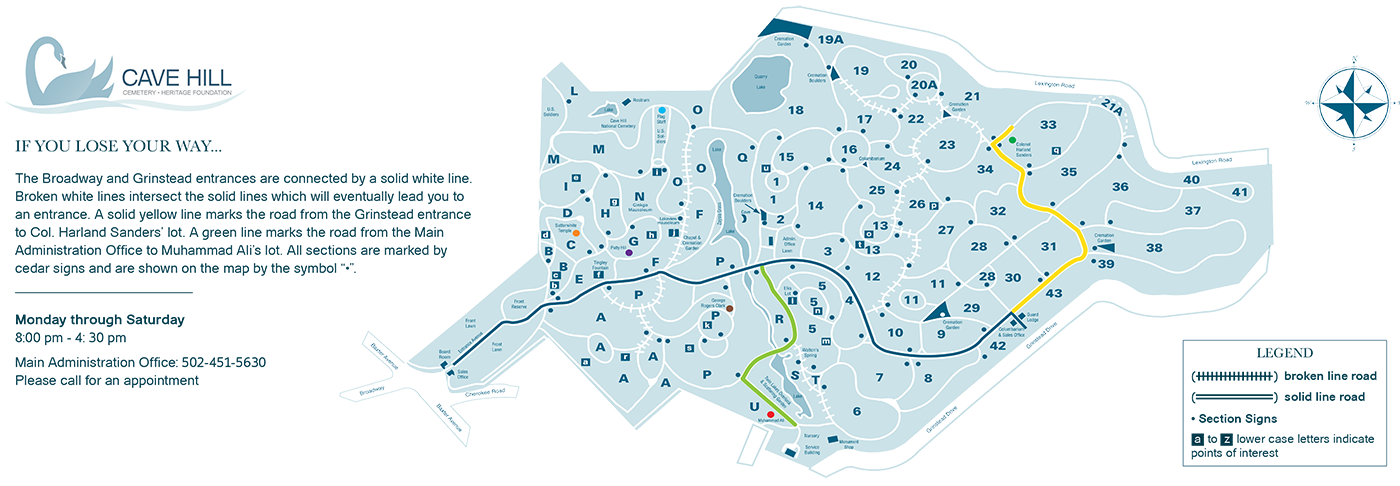
Click on the map to enlarge
Tour information
Points of Interest
Humanitarian, Civil Rights Leader, Heavyweight Boxing Titleholder. He championed peace and unity amongst the world.
Preston Pope Satterwhite gave many antiques to the J.B. Speed Art Museum. In 1928, he erected “Temple of Love” made of pink Italian marble, which is a copy of Marie Antoinette’s ornate structure in her Petite Trianon garden at the Palace of Versailles in Paris.
Burial site for over 5,500 soldiers killed in the Civil War and other American Wars.
“Founder of Louisville” and “Washington of the West” who was originally buried in the family cemetery at Locust Grove, the home of his sister Lucy Clark Croghan.
Founder of Kentucky Fried Chicken empire. His monument, which includes a bronze bust designed by his daughter Margaret, is suggestive of the KFC headquarters building.
Established the Louisville Jockey Club on Churchill land and created the Kentucky Derby in 1875.
Designed by Robert E. Launitz, "The father of monumental art in America", and was erected in memory of Minnie, the Wilder's only child, who died at the age of seven.
Distinguished political, business and educational leader. Served as United States Senator, President of University of Louisville, and President of L & N Railroad.
Features marble sculpture of the Angel Gabriel and four figures representing Faith, Hope, Mercy and Religion.
Cave Hill’s first superintendent whose widow placed a triple sided monument with a club-moss carving which was the badge of the Ross clan, and a special favorite of David Ross.
Erected in 1922 as a public memorial to William and George H. Tingley, who were brothers and individually achieved success as a wagon maker and as superintendent of the Louisville school system. It was restored in 2004.
Built in 1892 as a Watchman’s Shelter House. Covered in Oak bark in St. Andrews cross pattern. This is a copy of Marie Antoinette’s gardeners cottage in her Petite Trianon garden in Paris. It is one of the oldest examples of rustic architecture in the United States.
The family sold 49 acres to the Cemetery in 1863 with agreement that the fence around the family lot would remain.
Was the Kentucky Giant at 7'8” tall. Drove a hackney coach and ran the Big Gun Tavern in Shippingport.
One of the few gothic revival designs attributed to the prominent Louisville architect, Henry Whitestone.
Purchased by the Elks as a burial site for members and features a life size bronze elk.
Creator of the Confederate uniform and the flag of the Confederacy. Portrait painter of Jefferson Davis and Abraham Lincoln.
Symbolic monument in form of a tree with branches removed and individual headstones resembling logs, for Edwin Vivian Thompson, landscape gardener and farmer.
Family contributed money to build Sts. Mary & Elizabeth Hospital in 1872 in memory of their mother Mary Elizabeth Breckinridge Caldwell. Sisters married European royalty.
Prominent Louisville businessman and philanthropist. Inventor of the Hot Brown Sandwich.
Features a likeness of Leonardo da Vinci’s Last Supper painted on glass in rear window.
A professional baseball player and one of the best right-handed hitters and fighters ever. Used John Hillerich’s bats to create the Louisville Slugger.
Editor of The Journal newspaper; later changed to The Courier Journal. His name made famous Louisville’s Expressway.
A bellboy at the Galt House, became an entrepreneur and developed the beautiful Seelbach Hotel.
President of the Louisville Water Company. Created the filtration system and Crescent Hill swimming pool.